The questions people actually ask at the counter in Parker, answered the way we answer them in person. Every piece is weighed, tested and quoted in front of you, against live spot prices, with no obligation to sell.

Bullion is priced against the live spot price of the metal on the day you visit, and we pay the best prices we can on gold, silver and rare coins. There is no single fixed number, because spot moves through the day and because what a piece is worth depends on its metal content and, for collectible coins, its date, mintmark and condition. Every piece is weighed, tested and quoted in front of you, so you watch the number being made rather than being handed one.
For bullion, the quote starts from the metal: weight multiplied by purity gives the troy ounces of gold or silver in the piece, and that is priced against live spot. A one ounce American Silver Eagle contains one troy ounce of .999 silver. A one ounce American Gold Eagle contains one full troy ounce of gold. For collectible and rare coins the metal is the floor, not the answer, and the coin is evaluated on its own merits.
These are the published standards every dealer works from, so you can do the arithmetic before you walk in.
| Coin | Silver content |
|---|---|
| Pre-1965 dimes, quarters, half dollars (90% silver) | about 0.7234 troy oz per $1 of face value |
| Morgan and Peace silver dollars | about 0.7734 troy oz each |
| 1965 to 1970 Kennedy half dollars (40% silver) | about 0.1479 troy oz each |
| 1942 to 1945 war nickels (35% silver) | about 0.0563 troy oz each |
| American Silver Eagle | 1 troy oz of .999 silver |
| Canadian Silver Maple Leaf | 1 troy oz of .9999 silver |
A common-date, circulated Morgan or Peace dollar is bought on its silver content: about 0.7734 troy ounces of silver per coin, priced against live spot. Key dates, better mintmarks and high-grade or certified examples are worth more than the silver in them, sometimes far more, and those are evaluated individually rather than by weight.
A standard roll of 40 quarters is $10 of face value, which holds about 7.23 troy ounces of silver when the coins are uncirculated, and slightly less once they have worn. Multiply that by the live spot price of silver to get the metal value. The homepage melt value calculator does this arithmetic for you at current spot.
Because the metal price does. Gold and silver trade continuously and spot can move several percent in a week, so a quote reflects the market at the moment you are standing at the counter. That is also why we quote on the spot rather than giving numbers over the phone that would be stale by the time you arrive.
We are a dedicated coin and bullion dealer rather than a general-purpose lender, so precious metal is what we price all day. We buy and sell gold, silver, coins and bullion: best prices paid. The honest way to find out is to bring the piece in, watch it weighed and tested, and compare the number against anywhere else. There is no obligation to sell.
Watch it being made. Every piece is weighed and tested in front of you, bullion is priced against the live spot price you can look up yourself on your phone, and nothing happens in a back room. Take the number, go away and think about it, and come back if you want to. Nobody will pressure you.
No. Walk-ins are welcome Monday to Friday, 11am to 4:30pm, and the shop is closed Saturday and Sunday. If you are bringing a large collection or an estate, a quick call ahead at (303) 578-8288 helps us plan around it.
The items, anything that came with them such as holders, certificates or paperwork, and a government-issued photo ID. Colorado requires precious metal dealers to record the seller's identification for purchases from the public, so a driver's license is part of every transaction.
No to both, and please do not clean coins. Bring a collection exactly as it is: loose, in tubes, in albums, in a coffee can. Sorting is our job. Cleaning is actively harmful, because tarnish does not reduce the value of bullion silver and polishing can strip the collector value from a coin that had some.
A few pieces take minutes. A full estate or a lifetime collection is worked through at the counter piece by piece, which takes as long as it takes, which is why calling ahead for a large lot helps.
No. There is no obligation at any point. Take the quote, think it over, get other numbers, come back another day. The door is open Monday to Friday.
Cash is the usual way a transaction is settled, and a single ounce of gold is routinely paid out in cash on the spot. For a larger amount it depends on how much cash is in the shop that day, so a bigger payout may be written as a check instead, and those clear quickly. If you are bringing in a large lot, call ahead at (303) 578-8288 and we will tell you what to expect.
We quote on the spot and settle it before you leave. Cash is the usual way a transaction is settled, and a single ounce of gold is routinely paid out in cash. For a larger amount it depends on how much cash is in the shop that day, so a bigger payout may be written as a check instead, and those clear quickly.
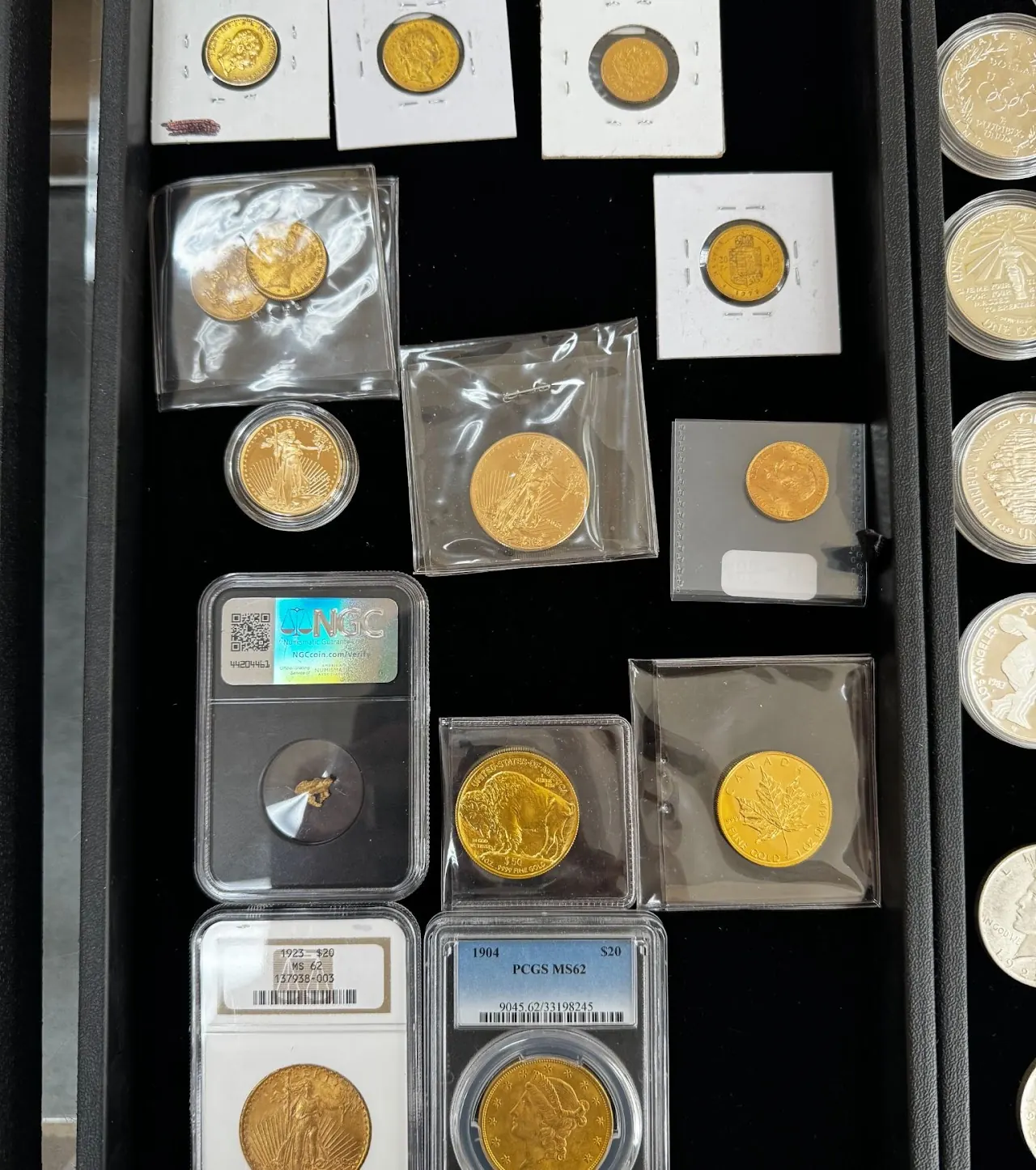
Gold and silver bullion in any form, and coins of every era: American Silver Eagles, American Gold Eagles, Gold Buffalos, Canadian Maple Leafs, silver rounds and bars, 90% U.S. silver coins, Morgan and Peace dollars, rare and collectible coins, and whole estate collections. Bring a single piece, an inheritance, or a lifetime of accumulation.
We focus on coins, rounds and bars. Call (303) 578-8288 before bringing jewelry, sterling flatware or scrap so we can tell you whether it is something we buy, rather than having you make the trip for nothing.
Single coins are welcome. Any size order, in either direction: one Silver Eagle or a multi-ounce position.
Yes, and it is a large part of what we do. We go through the entire collection with you at the counter, weigh and test every piece and quote it in front of you, with no obligation to sell. There is a full explanation on the estate liquidation page.
Yes. Gold and silver bullion, bars and coins, priced against live spot, with no Colorado sales tax on bullion or coins. See buying bullion.
Every piece is tested as part of the quote, which is one of the reasons the evaluation happens in front of you rather than out of sight. Counterfeit bullion exists and testing is routine, not an accusation.
No, on bullion and coins. Colorado Revised Statutes 39-26-706 exempts all sales of precious metal bullion and coins from state sales tax, in any size order. The statute defines coins as monetized bullion or other money of gold, silver, platinum or palladium that is or was legal tender, and bullion as refined precious metal whose value depends on metal content rather than form. Jewelry and commemoratives are not covered by the exemption.
Sales tax applies to purchases, not to selling, so it does not arise when you are the seller. It matters when you are buying, and in Colorado it means no sales tax on bullion or coin purchases.
Colorado law requires precious metal dealers to record identifying information for purchases of secondhand property, which includes coins, from members of the public. A government-issued photo ID covers it. It applies to every dealer in the state, not just this shop.
That depends on your own circumstances and is a question for a tax professional, not a coin shop. We can tell you what your metal is worth; we cannot advise you on your taxes.
Spot is the live market price of one troy ounce of a metal. It is the reference every bullion quote starts from, it moves continuously while markets are open, and you can look it up on your phone while you stand at the counter.
Melt value is what the metal inside an item is worth at current spot: weight multiplied by purity multiplied by spot. It is the floor for a bullion piece and a reference point, not an offer. The homepage has a free melt value calculator for common U.S. gold and silver coins.
A bullion coin is bought and sold for the metal it contains, so condition barely matters and a worn one is worth close to a pristine one. A numismatic or collectible coin carries value above its metal because of its date, mintmark, rarity and condition. The same coin can be either depending on which of the two is larger.
Precious metals are measured in troy ounces, which are heavier than the ounces on a kitchen scale: one troy ounce is 31.1035 grams, against 28.35 grams for an avoirdupois ounce. Using the wrong one understates a quantity of gold by about nine percent, which is why every quote here is made on a scale calibrated for troy weight.
If your question is not here, bring the piece in Monday to Friday, 11am to 4:30pm, or call (303) 578-8288. We would rather answer it at the counter than have you guess.